Why Your Sourdough is Flat (And 3 Italian Tricks to Fix It)
Why Your Sourdough is Flat (And 3 Italian Tricks to Fix It)
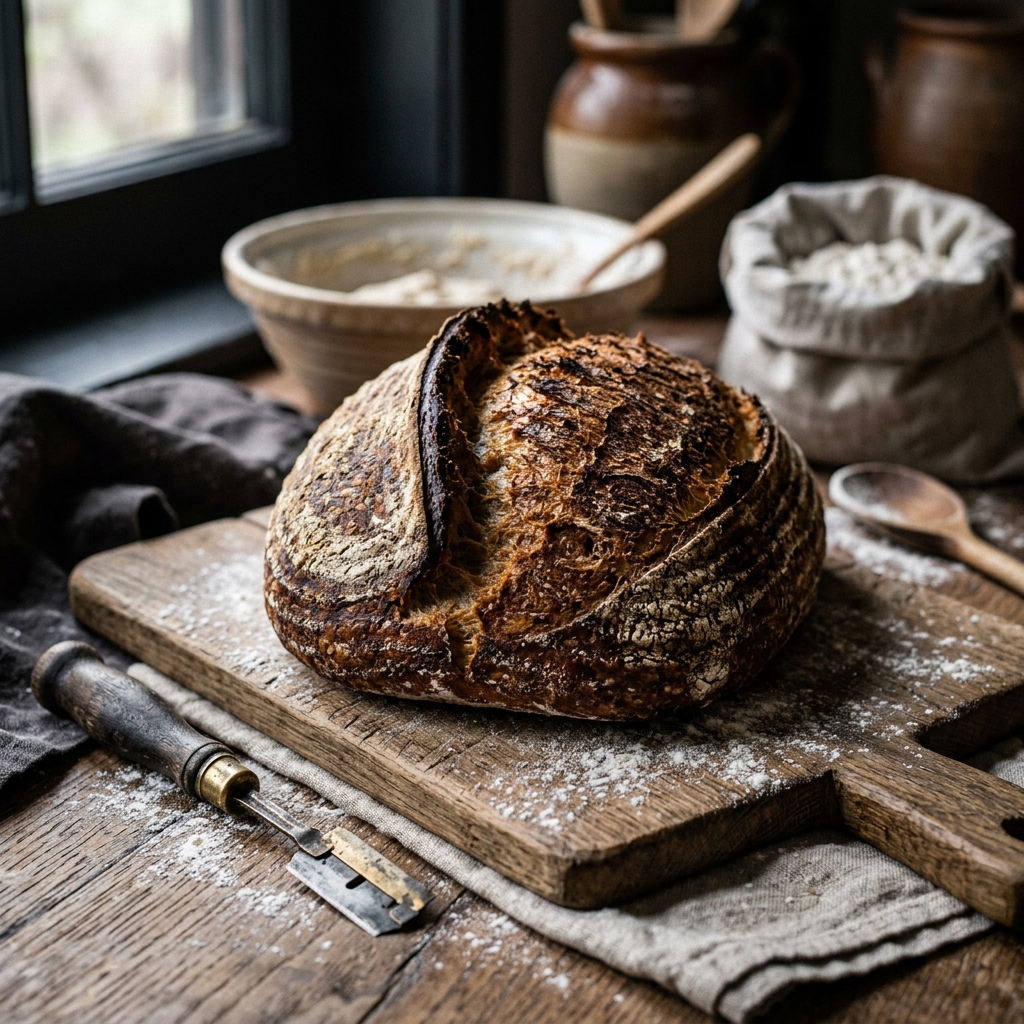
There is nothing more heartbreaking than nurturing a sourdough starter all week, performing delicate stretch-and-folds, and waiting hours for fermentation—only to pull a dense, heavy "frisbee" out of the oven.
If your sourdough isn't rising, isn't developing that massive oven spring, or is lacking the coveted open crumb, you are not alone. Sourdough is alive, and baking it is less about math and more about intuition.
In Italy, we don't stress over hydration math; we read the dough. If your bread is flat, it comes down to three main culprits: Starter Strength, Gluten Development, and Fermentation Timing.
Here are the exact reasons your bread fails, and three Italian tricks to fix it forever.
The Culprit: Understanding the "Sourdough Frisbee"
Before we jump into the fixes, you need to diagnose why it went flat.
- Overproofing: Your dough ran out of food before it hit the oven. The yeast exhausted the sugars, the gluten matrix degraded into a soupy puddle, and when it hit the heat, it had no structure left to trap steam.
- Underproofing: Your bulk fermentation was too cold or too short. The yeast never produced enough gas, resulting in a tight crumb with massive, random "fool's crumb" tunnels near the top.
- Weak Starter: Your starter wasn't truly at its peak when you mixed the dough.
- Poor Shaping: You didn't create enough surface tension, allowing the dough to spread outward (like a pancake) instead of upward.
Let's fix all of this.
Trick 1: The "Galleggiante" (Float Test) Deception
In America, everyone teaches the "Float Test"—drop a spoonful of starter in water, and if it floats, it's ready.
This is a lie.
A weak starter can trap enough minimal air to float, but completely fail to leaven 1000g of dense flour.
The Authentic Trick: Watch the dome, not the float. When you feed your starter (or Lievito Madre), it will rise. As it hits its absolute peak strength, the top of the starter will form a convex dome ∩.
The second that dome begins to flatten into a straight line is the exact moment you must mix your dough. If it becomes concave ∪ and falls back on itself, it is too late—it is hungry and degrading. Mix on the dome, never on the drop.
Trick 2: The "Autolisi" (Autolyse) for Extensibility
If your dough feels stiff, tears easily during stretching, or refuses to rise, your gluten development is failing.
The Authentic Trick: Always perform an Autolyse. Before introducing your sourdough starter or salt, mix only your flour and water together. Let it sit on the counter for exactly 60 minutes.
During this hour:
- Flour fully hydrates.
- Enzymes (protease and amylase) break down the starches into sugars for the yeast to eat later.
- Gluten bonds begin forming naturally without kneading.
When you add the starter and salt an hour later, the dough will be silky, highly extensible, and already building an incredible structural envelope capable of holding massive amounts of gas.
Trick 3: The "Laminazione" (Lamination) for Extreme Oven Spring
If your bread rises nicely in the bowl but collapses into a puddle the second you turn it out onto the counter, your dough lacks structural tension.
Instead of endlessly kneading (which oxidizes the dough and destroys flavor), we build structure through folding.
The Authentic Trick: Dough Lamination. During the middle of your bulk fermentation, mist your countertop with a little water (not flour). Turn the dough out and gently stretch it from the center outwards until it is a massive, paper-thin rectangle covering your entire counter (so thin you can almost see through it—the "windowpane" effect).
Then, fold the left third into the center, the right third over that, then roll it up from the bottom like a towel.
This technique layers the gluten strands on top of each other structurally, like making puff pastry. When it hits the hot Dutch oven, the trapped steam will forcefully push those layers upward, resulting in violent oven spring and a gorgeous, splitting ear.
The Master Setup
To truly eliminate flat bread, stop rushing.
- Feed the starter and wait for the Dome.
- Mix flour and water for a 60-minute Autolyse.
- Mix in starter and salt.
- Perform 3 stretch-and-folds, followed by 1 extreme Lamination.
- Let it bulk ferment until double in size with jiggly bubbles on the surface.
- Shape it tightly, let it cold-proof in the fridge overnight, and bake straight from the cold directly into a 500°F (260°C) preheated Dutch oven.
Master these, and you will never bake a frisbee again.